Footy fields and tech giants: how the case for the social media ban was built
Australia’s teen social media ban came into effect on 10 December 2025, putting the country at the forefront of a global debate about children’s safety online. Three months on, it’s far too soon to know if the ban is working. But we can examine how the case for it was made: how the foundations were laid for such an ambitious policy, and what the rhetorical arc tells us about how political consent was built.
Australia’s teen social media ban came into effect on 10 December 2025, putting the country at the forefront of a global debate about children’s safety online. Three months on, it’s far too soon to know if the ban is working. But we can examine how the case for it was made: how the foundations were laid for such an ambitious policy, and what the rhetorical arc tells us about how political consent was built.
Approach
I scraped 2,010 speeches and transcripts from the Prime Minister’s website, covering 23 May 2022 to 6 March 2026 and containing 2,454,641 words in total. For interviews, I included only the Prime Minister’s words. I then used BERTopic to identify which passages were relevant to the social media ban, and a Structural Topic Model (STM) to examine how the framing of the policy changed over time. The first step finds the signal, and the second tracks how it evolved.
NoteTechnical details
After splitting the transcripts into 24,503 smaller passages, I used BERTopic to identify clusters of similar language across the corpus. One of these 73 clusters clearly corresponded to discussion of the proposed social media age restriction.
I chose this approach instead of simply searching for keywords and phrases like “social media ban” because keyword searches can be brittle. They depend on anticipating exactly how an issue will be described and can easily miss relevant passages or include unrelated ones. Topic modelling allowed the discussion of the social media ban to emerge from the language of the corpus itself.
I then manually reviewed the 410 passages from 190 transcripts assigned to this cluster, keeping only those where social media was framed as a policy problem affecting children and young people requiring government action. Passages where social media came up incidentally, or in unrelated contexts such as political discourse, misinformation, or Albanese’s own social media use, were excluded. This left 227 passages from 95 transcripts. The fact that only 54% of these included the words “social media” and only 6% included “social media ban” confirms that keyword search alone would not have reliably identified the relevant material.
To confirm that I had identified the bulk of relevant text, I also reviewed passages mentioning social media that were not assigned to the social media ban topic. These were mostly references to social media in other contexts or mentioned the ban only in passing, suggesting the cluster captured the policy discussion well.
Unlike my earlier analysis of Prime Minister Scott Morrison’s language in general, here I was specifically interested in how discussion of the social media ban evolved over time. I fitted a Structural Topic Model to this subset using R, with date and speech type as covariates. STM allows topic prevalence to vary with metadata such as time, making it well suited to examining how language shifts during a policy debate. The model was fitted on a document-feature matrix with stopwords, punctuation, and low-frequency terms removed, and with common bigrams compounded as single tokens prior to lemmatisation.
An eventful few years
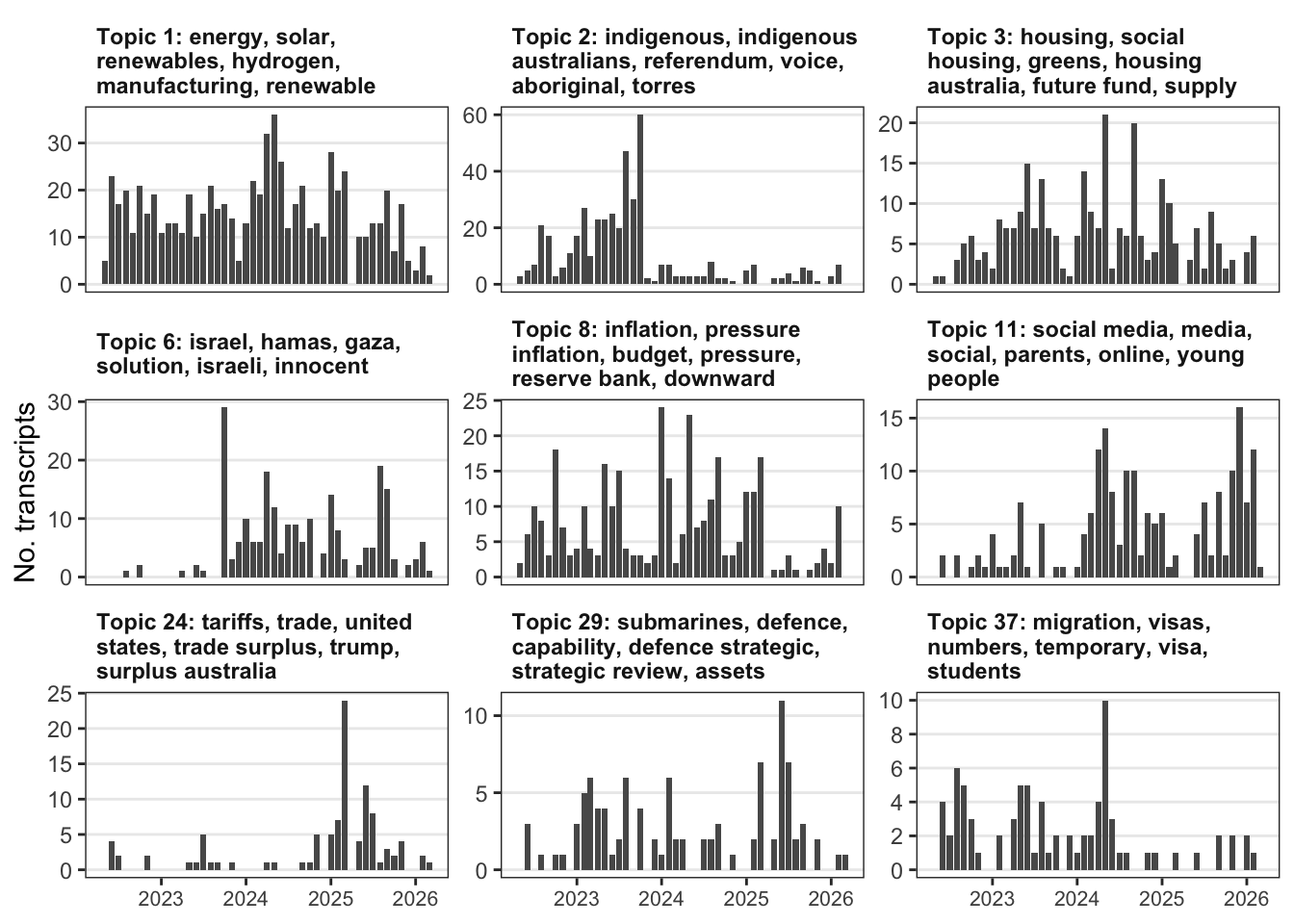
Before zooming in on the social media ban, it’s worth pausing on what else is in this corpus. The plot below shows a subset of the 73 topics BERTopic identified, with the words and phrases most associated with each giving a sense of what they capture.
Some topics correspond closely to discrete political events. The Voice referendum topic peaks sharply in 2023 and then drops to near zero, suggesting it captures the referendum campaign itself rather than Indigenous affairs more broadly. This is a sign that the model is capturing meaning rather than just shared vocabulary. Other topics reflect ongoing pressures rather than discrete events: energy policy, housing, and inflation appear more consistently across the period.
The social media ban emerges as the 11th most common topic overall. Given that it only appears from 2024, and that it’s competing with wars, a cost-of-living crisis, a referendum, and an increasingly turbulent global trade environment, that says something about how much political energy went into this policy.
The language of the social media ban
Before tracking how the rhetoric shifted over time, it’s worth looking at the overall vocabulary. The plot below shows the terms most enriched in the social media ban cluster relative to the rest of the corpus. This is the language that most distinctively characterises how Albanese talked about this policy.
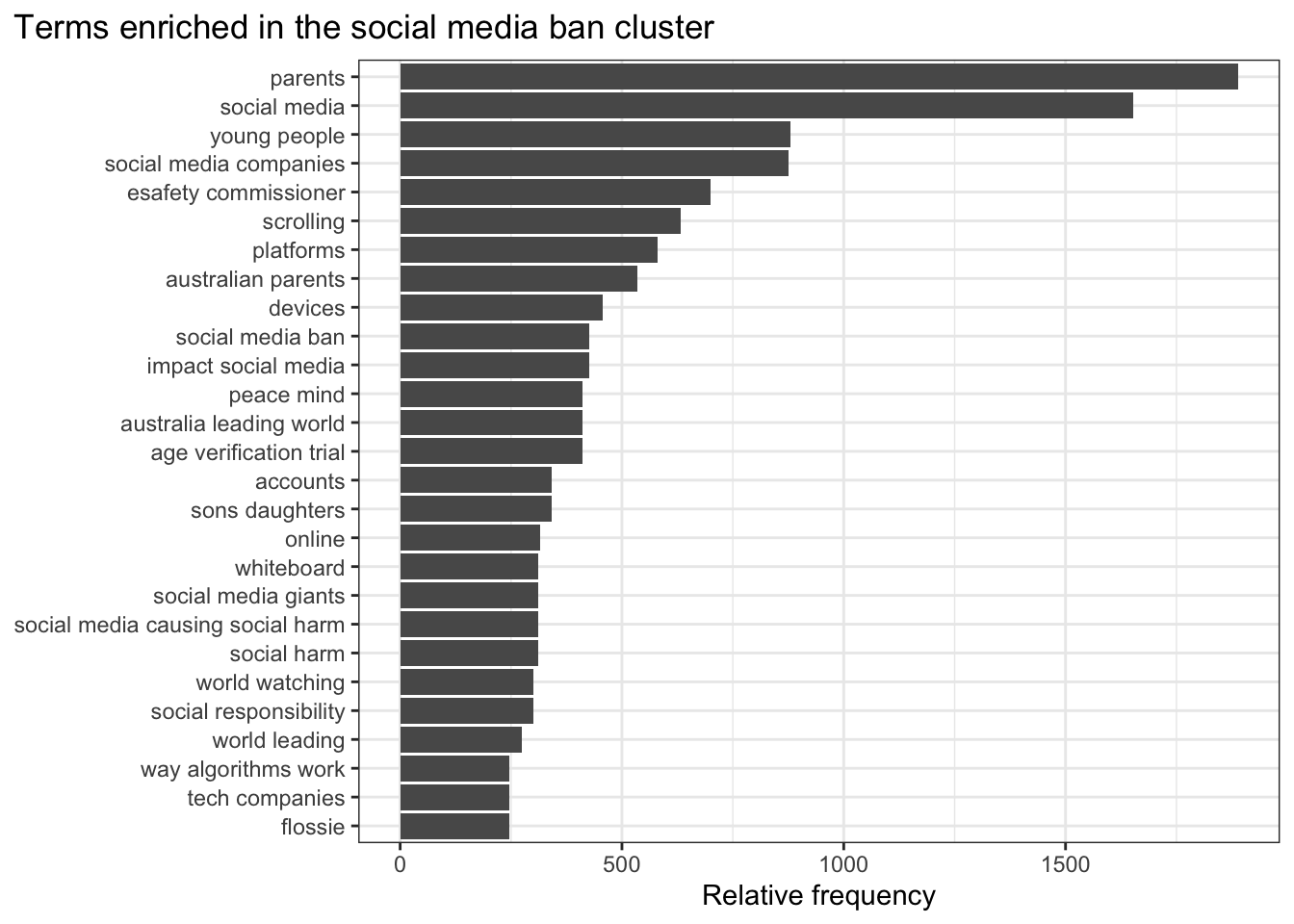
Strikingly, “parents” is the single most enriched term, ranking above “social media” itself. The policy is nominally about young people, but the language is overwhelmingly directed at their parents. “Young people” appears third, but as we’ll see, they appear mostly as objects of concern rather than as participants in the debate. Across the 227 passages, parents are mentioned 101 times; young people or teens just 68. Young people are the subject of the ban, but the rhetoric telegraphs clearly that it was demanded by parents, justified by parents, and sold to parents.
“Flossie” and “whiteboard” might seem out of place, but both refer to the same source: a 12-year-old from Tasmania who visited Parliament House with a whiteboard, having independently researched the harms of social media. Albanese returned to her story repeatedly. She is one of the very few young people who appears by name in this corpus.
Then there’s “scrolling,” which ranks higher than “social media ban” itself. The discourse was as much about devices, platforms, and addictive design as it was about the legislation. The ban was the policy response, but the harm was consistently described in the language of compulsion.
The ban’s rhetorical toolkit
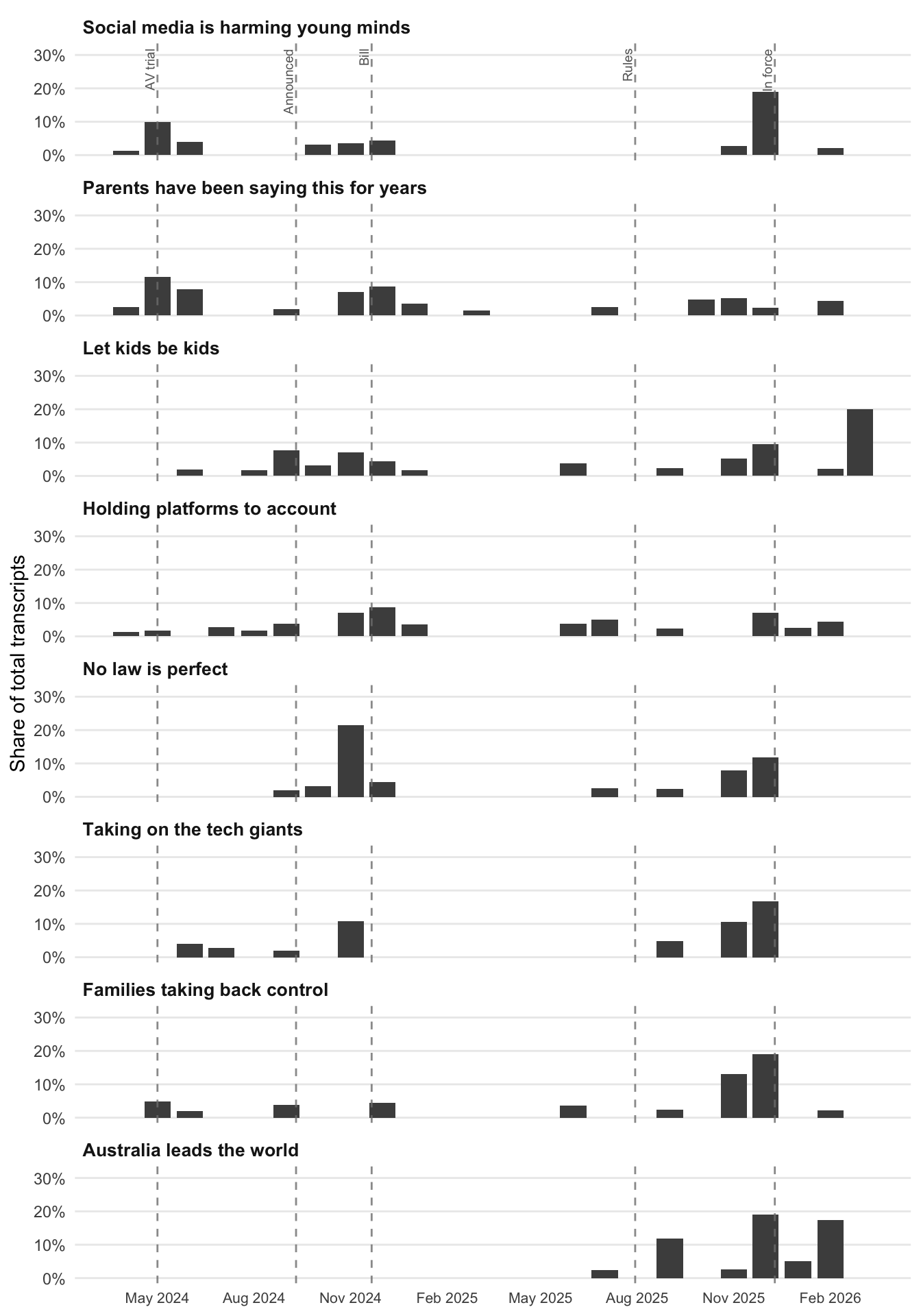
Using STM, I identified eight main framings Albanese used when discussing the ban. Together they form an interlocking rhetorical toolkit: a set of messages that did different jobs at different moments and were deployed in a sequence that tracks the policy lifecycle almost perfectly.
The plot below shows the full arc, with each framing’s prominence shifting across the policy lifecycle: from early problem establishment through the legislative period, the quieter interval while operational details were worked out, and the victory lap around commencement.
NoteTopic keywords
The pattern falls into three broad phases: establishing the problem, pushing through the legislation, and declaring victory.
Building the case
Three early framings did the groundwork of establishing the problem before any formal policy commitment.
Social media is harming young minds is the foundational framing, and the one that had to be established before anything else could follow. Without a convincing account of harm, there is no case for the ban. It appears from the very start and resurges most strongly at commencement.
Albanese reached repeatedly for scientific-sounding language:
“There are chemical reasons, scientific reasons, why the algorithms and the way that scrolling will impact chemicals in the brain and encourage them to continue.”
The invocation of chemistry and science lends authority, but the framing is notably vague. The rhetorical move is to borrow the credibility of science without engaging seriously with the evidence.
Parents have been saying this for years established that everyone already knew the problem existed. It appears very early and recurs consistently throughout. Albanese positioned the ban not as a government initiative developed in a vacuum but as a response to something parents had been demanding for years:
“I think parents on the side of netball courts and football ovals over this weekend, like last weekend, will all have a common theme, which is they talk about how do we get our kids off devices?”
The netball court and football oval image recurs throughout. Albanese mentioned netball 17 times in the context of the ban, accounting for a third of all his netball mentions across the entire corpus. It’s a deliberate rhetorical device that conjures a very specific kind of Australian parent: suburban, sporty, not an activist, just someone standing on the sidelines of a weekend game worrying about their kids. It grounds the policy in the heartland rather than in Canberra. By establishing this early, before any formal policy commitment, Albanese was building moral authority that would be harder to challenge later. After all, the ban was simply what parents had been asking for.
Let kids be kids kept the policy tethered to its human rationale while the legislative machinery moved forward. It rarely dominates but it never disappears either, and it’s still the strongest framing in early 2026, suggesting it remains the default register when Albanese talks about the ban now that the policy debate has settled:
“There is nothing social about some social media taking our young Australians away from real friends and real experiences.”
“Real” does quiet but significant work here. It implies that online connection is somehow artificial or counterfeit, and that authentic childhood exists only in physical space. It’s an emotionally resonant framing, but one that sidesteps any serious engagement with how young people actually experience their online lives.
Getting it through
Once the case had been established, a different set of framings managed the politics of turning the commitment into legislation.
Holding platforms to account peaks around the introduction of the Bill, when the question of what platforms would actually be required to do became unavoidable. But it never dominates even at its peak. The technical question of how platforms would comply was always secondary to the broader moral argument that they should.
No law is perfect did more urgent work. It offered a pre-emptive defence against the obvious objection that teenagers would simply find workarounds. It spikes sharply around the Bill’s introduction and resurfaces again just before commencement:
“We don’t argue though, very early on, we wanted to make it clear that there would be not a perfect implementation, because this is world-leading, and you don’t have a perfect outcome from a ban on under 18s buying alcohol.”
The alcohol analogy was Albanese’s go-to comparison. The double peak tells us that this framing wasn’t just pre-empting criticism during the legislative debate, but actively managing expectations again once the ban was about to go live. Imperfect implementation is framed not as a failure, but as an expected condition of any world-leading reform.
The victory lap
The final three framings all peak around commencement and work together as a cluster, each doing a different piece of the same celebratory work.
Taking on the tech giants casts the policy as a populist stand against powerful corporate interests:
“This is the community demanding an appropriate government response and demanding that social media companies show social responsibility.”
Albanese is simultaneously claiming credit for getting the legislation through and insisting it was driven from below. The acknowledgment of Peter Dutton’s bipartisan support recurs here too, though always framed in a way that positions Albanese as having arrived first.
Families taking back control recasts the policy as an empowerment story:
“This is the day when Australian families are taking back parents’ power from these big tech companies and they’re asserting the right of kids to be kids and for parents to have greater peace of mind.”
The framing is explicitly about parents reasserting power, but the voice of young people is largely absent. This is a pattern that runs through the entire rhetorical toolkit. When Albanese talks about the social media ban, young people appear almost entirely as objects of concern rather than subjects with agency: they are being harmed, being protected, being given back their childhoods. They rarely get to speak in the account of why the ban was necessary.
Australia leads the world is the final framing, and in some ways the most revealing. It first appears meaningfully several months before the ban came into effect and remains elevated into 2026:
“The fact that it has been followed in Spain, France, Denmark, Indonesia, Malaysia, the UK are considering it. And this report of the United States giving consideration as well shows that Australia can lead the world with reform.”
This is where the rhetoric does its most ambitious work. The victory narrative was being constructed in advance, before anyone could assess whether the ban was working. By the time it took effect, the framing was already established. Language like “it’s a success already” and “success is the fact that we’re having this discussion” appeared on the very first day the ban came into force. The motivation for the ban was initially anchored in harm to young people, but by the time it took effect, success had been redefined as the existence of a global conversation.
Final thoughts
The playbook has a clear sequence. Establish a harm that is felt before it is measured. Ground the response in the authority of ordinary people rather than experts or institutions. Pre-empt criticism by lowering the bar for success. Then declare victory in terms you defined yourself. Together, these moves make the policy very difficult to challenge, because the terms of evaluation have been quietly shifted before the debate properly begins.
Crucially, this sequence doesn’t require the voices of the people the policy is about. The ban affects millions of Australian teenagers, but they appear in this rhetoric almost entirely as passive figures who are alternately harmed, protected, or given back their childhoods. The one young person who recurs by name got there by doing her own research, writing it on a whiteboard, and carrying it into Parliament House. And most importantly, agreeing with the adults.