A guided tour of prime ministerial speech
I’ve collected four years of just about everything Anthony Albanese has said as Prime Minister, spanning 2,028 speeches and transcripts. This post looks at the big picture: what does the PM talk about, how has that changed over time, and what patterns emerge when you ask an algorithm to make sense of 2.5 million words of political rhetoric?
I’ve collected four years of just about everything Anthony Albanese has said as Prime Minister, spanning 2,028 speeches and transcripts. Earlier this year I used topic modelling on a similar dataset to analyse how the government built the rhetorical case for the social media ban. Although that analysis focussed on a single policy, the model also found dozens of other topics across the full dataset. This post looks at the big picture: what does the PM talk about, how has that changed over time, and what patterns emerge when you ask an algorithm to make sense of 2.5 million words of political rhetoric?
Approach
I split each speech into shorter passages, then used BERTopic to cluster them by meaning. The model found 89 topics. The full list is available below, but a few are new since my previous analysis. For example, artificial intelligence and Iran emerged as distinct topics in the last few months of the corpus.
NoteClick to see all topics
NoteTechnical details
Speeches and transcripts were split into 24,743 passages of 30–150 words. For interview transcripts, I included only the Prime Minister’s words. I used BERTopic with sentence-transformer embeddings, UMAP for dimensionality reduction, and HDBSCAN for clustering, then merged down to 89 topics. About 8,800 passages were not assigned to any topic. The model was retrained on the full corpus to June 2026, so topics differ from the social media ban post.
Deaths, disasters, and the months when nothing else matters
Sometimes it feels like the PM has been talking about the same thing for weeks straight. As it turns out, we can quantify that.
I used a measure called the Herfindahl–Hirschman index (HHI) to examine how much variety in the PM’s speech there was month-to-month. High values mean a single topic dominated that month, whereas low values mean the PM’s attention was spread across many topics. Underneath the main chart I’ve broken out the topics driving the main peaks.
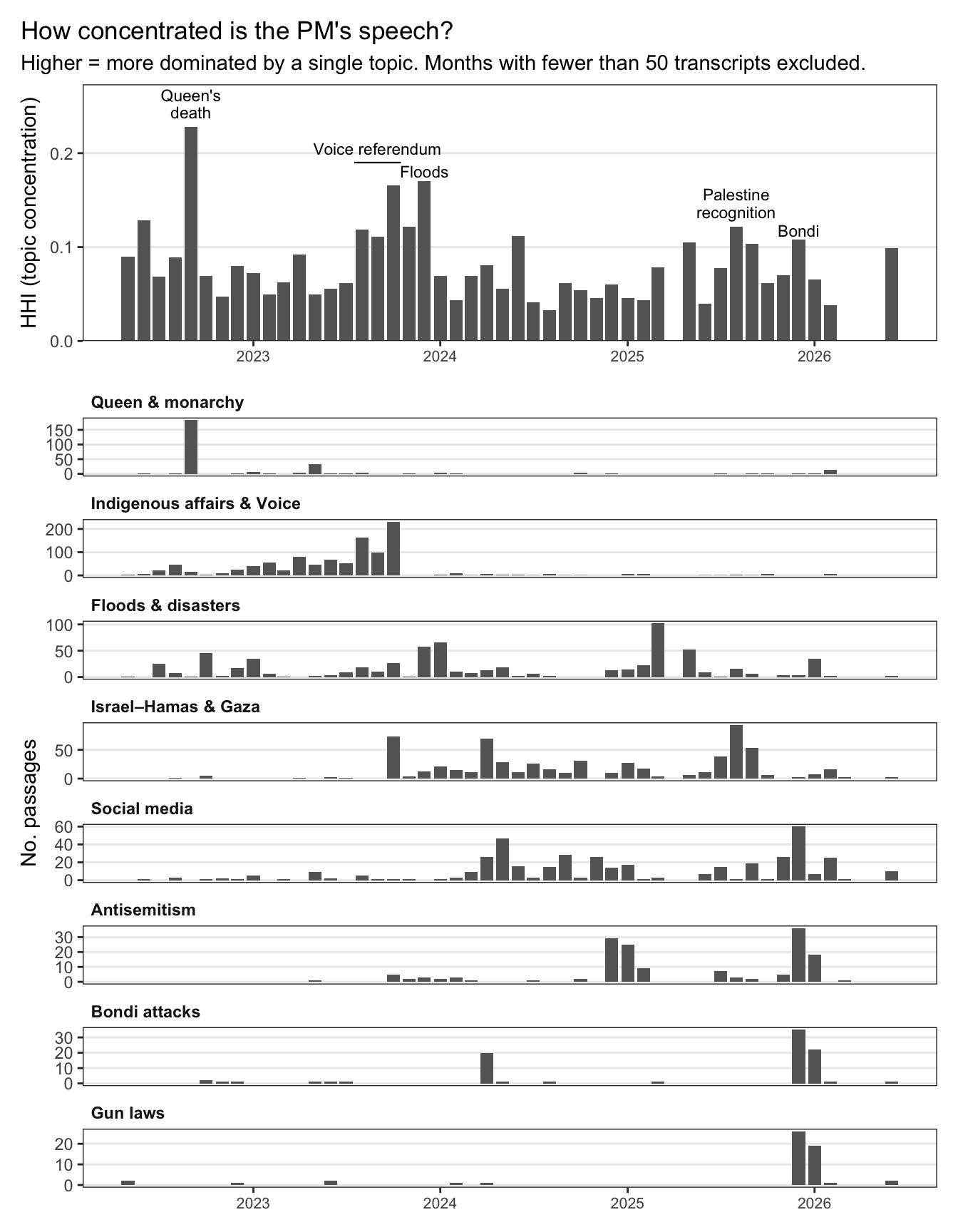
The month where the PM’s speech was most dominated by a single topic was September 2022, the month of the Queen’s death. That month, 183 passages were about the Queen and monarchy across 33 speeches and transcripts. For context, the next most common topic (the pandemic) appeared just 17 times. Everything else was background noise.
Other months where one topic dominated correspond to the Voice referendum, floods, and Palestine recognition. Usually a high HHI means a single topic has taken over, as we saw for the Queen’s death. The Bondi massacre was different. Rather than dominating through a single topic, it consumed the PM’s speech across four distinct registers at once: the attack itself, antisemitism, gun laws, and social media. Between them, these four topics crowded out almost everything else even though no single topic dominated.
A few other things stand out. The Voice referendum was a campaign rather than a moment, and accordingly appears as a sustained elevated period rather than a single spike. The antisemitism topic doesn’t track the Israel–Hamas topic neatly. It has its own peaks in late 2024 and early 2025. The Bondi attacks topic spikes twice because it captures both the Westfield attack in April 2024 and the massacre in late 2025. Despite involving distinct events, the PM’s language was similar enough that the model grouped them together.
What spikes and what stays
Looking through the list of topics, I’m struck by how many seemed to dominate everything for weeks only to vanish without a trace. In the plot below, I’ve grouped a selection of topics into three categories based on how much their frequency varies over time: event-driven, agenda, and routine.
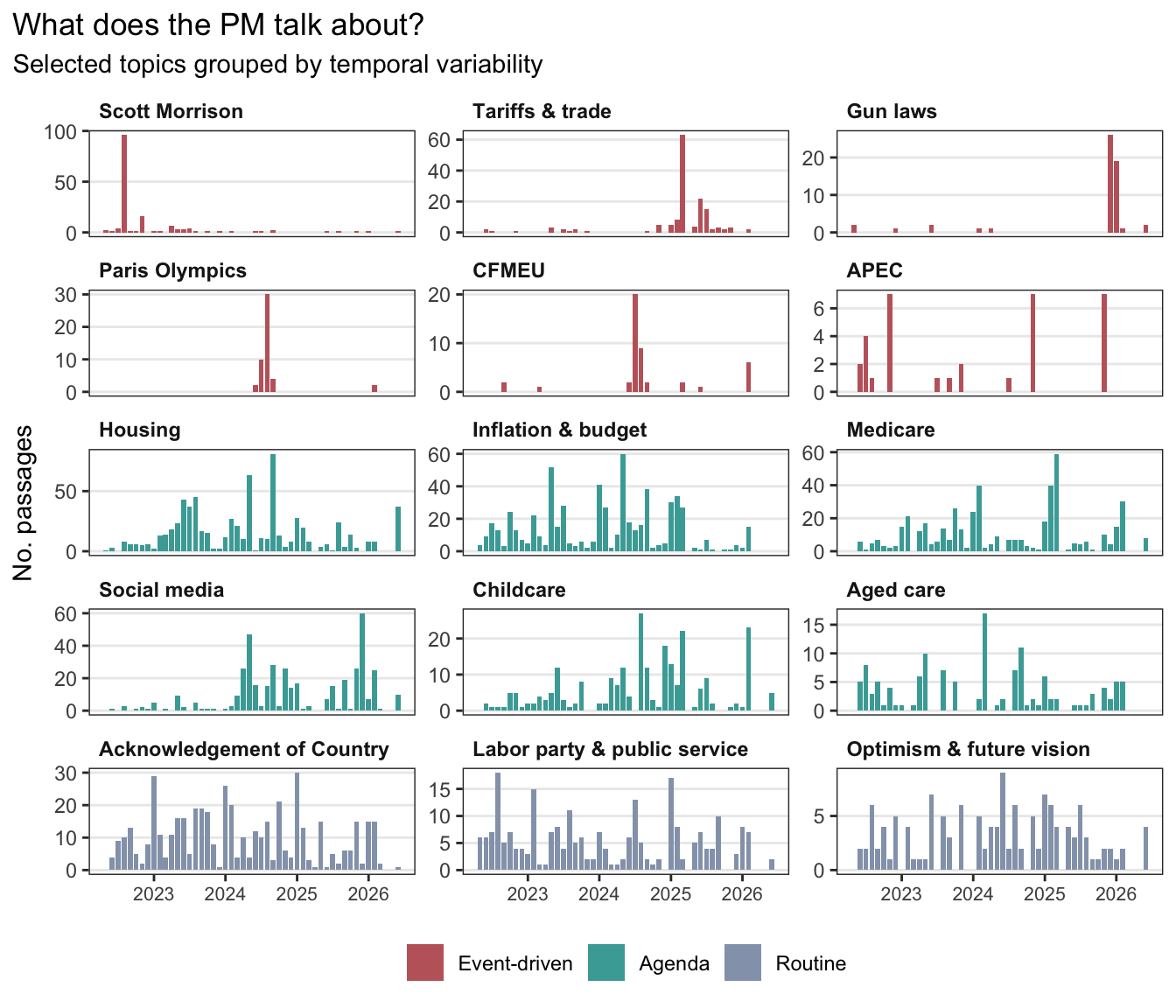
The event-driven topics (in red) are the most dramatic. They spike sharply then disappear. The Scott Morrison topic peaks in mid-2022 and dies almost immediately. Despite the label, it’s not really about Morrison. This topic is strongly associated with keywords such as “solicitor general”, “governor general”, and “Westminster”, indicating that this topic relates to the secret ministries scandal.
There’s a spike in the tariffs and trade topic that corresponds to Trump’s tariff war. We also see clear traces of events like the Paris Olympics and APEC. The gun laws topic sits at near-zero for years and then erupts over a two-month period following the Bondi massacre. It drops back to zero just as quickly.
The agenda topics (in green) have a slightly different shape, experiencing clear peaks and troughs but never quite dropping away to nothing. These are the topics where you can see the PM’s office making choices about what to talk about. Social media rises from almost nothing to a major topic. Medicare spikes sharply in 2025 but is otherwise at a lower steady state. Housing fluctuates across the whole period. The shapes reflect deliberate political attention.
The routine topics (in grey) are the background hum. Acknowledgement of Country, vague but optimistic language about the future, and boilerplate about the Labor Party and public service are always present and roughly flat.
Friends, enemies, and Yeppoon
Several topics are about political parties or politicians, and they’re some of the most revealing. The chart below shows the most distinctive keywords for each, with names filtered out. What’s left is the rhetoric associated with each party or figure.
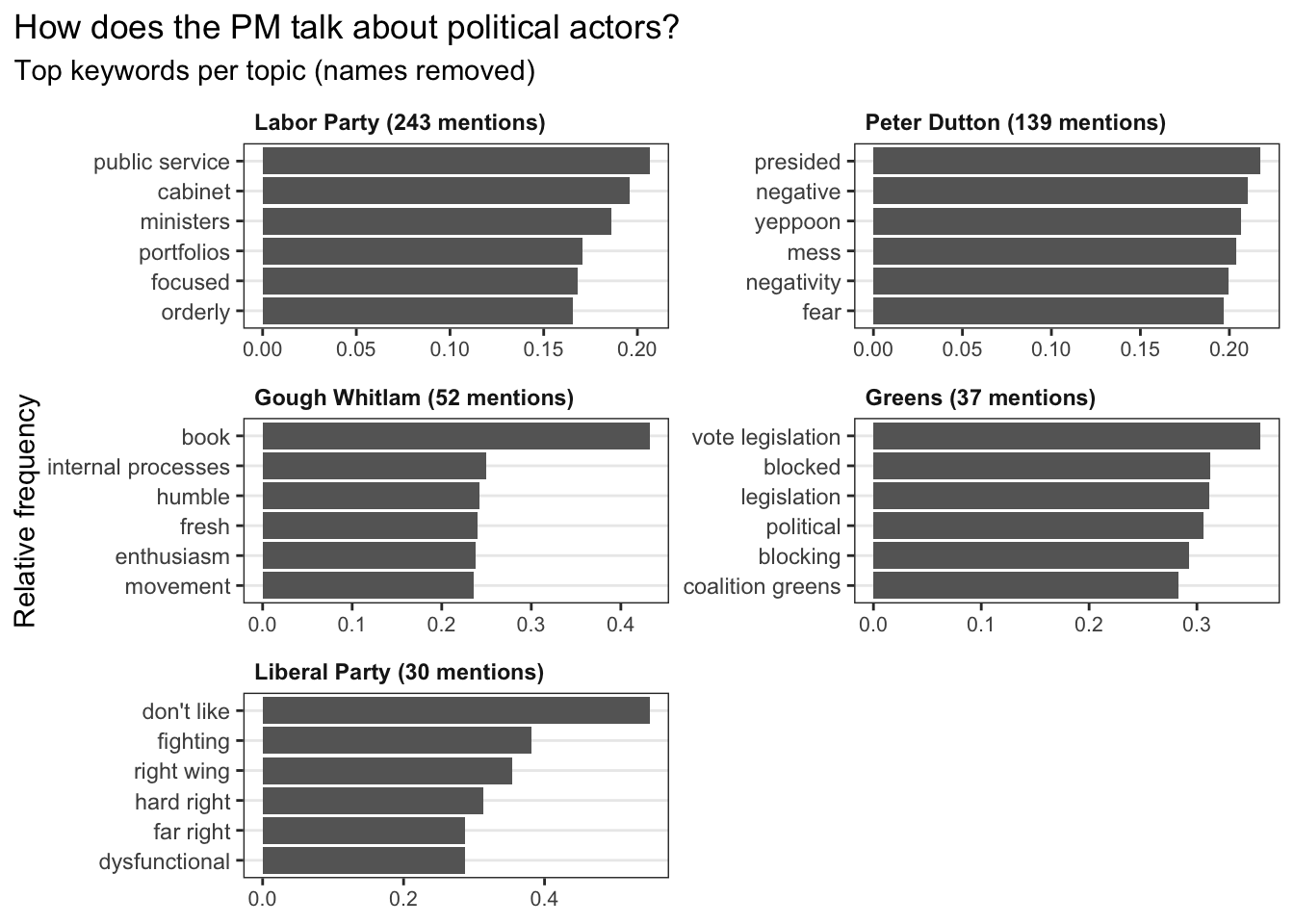
The Labor Party topic is the most common, and its keywords tell you exactly how the PM wants his own side perceived: “focused” and “orderly”, “cabinet”, “public service”. In contrast, the Liberal Party topic is “dysfunctional” and “fighting”. “Don’t like” also appears. In every case, the PM pointing out that the Liberals and Nationals don’t like each other.
Peter Dutton’s characterisation by the PM comes through loud and clear, with “mess”, “negativity”, and “fear” all strongly associated with the former Opposition Leader. Oddly, we also see “Yeppoon” in this topic. Albanese repeated a quip about Dutton not knowing his Yeppoon from his Yeppen so many times that it became a statistically distinctive keyword.
The Whitlam topic is surprising both for its existence and for how often it comes up. It peaks around the 50th anniversary of the Dismissal in November 2025, but it appears regularly throughout the whole period. “Book” is its most distinctive keyword simply because Albanese keeps turning up at launches of Labor political biographies where he invariably invokes Whitlam as a political ancestor. He consistently dwells on Whitlam’s character (“humble”, “fresh”, “enthusiasm”) rather than his policy legacy. “Free education” is not among the top keywords for this topic, appearing only once.
The Greens are mentioned less often than Gough Whitlam and rather less glowingly. The phrase “Coalition and Greens” is strongly associated with the Greens topic, as the PM often lumps them in together when explaining why legislation failed to pass (hence both “blocked” and “blocking”). Where the Liberal Party are dysfunctional, the Greens are obstructive.
One final thing worth noting is who’s absent. There are no topics for One Nation, the teals, the UAP, or the Nationals as a distinct entity. Notably, new Opposition Leader Angus Taylor has yet to earn his own topic.
Final thoughts
Political speech is brilliantly suited to topic modelling, because politicians repeat the same lines until they become structural features of their language. Rhetorical features like the Yeppoon joke and the footy oval parents we saw in the social media ban post aren’t just one-off phrases. They’re the building blocks of a political vocabulary, repeated often enough to become statistically visible.
That repetition is what makes the method work, but it’s also what the method reveals. The PM’s speech isn’t a series of individual responses to events. It’s a carefully choreographed system with its own patterns of attention and deliberately calibrated rhetorical registers. Some topics spike and vanish. Some are sustained by deliberate effort. Some are always there, so constant they become invisible. And some actors and issues simply don’t exist in the PM’s rhetorical universe at all.